Showing posts with label writing. Show all posts

Wednesday, October 28, 2015

Persuasive Writing


When trying to write to persuade someone or to build an argument, it is really hard to write down your reasoning in a way that makes sense. I mean, that can be hard to do as an adult, let alone in middle school!

When I sit down and talk to my students, it is so easy for them to tell me what they are thinking (HAHA) because let's face it, they all have opinions! But this doesn't always come off in their writing.

So, I got to thinking. They have so much good stuff to say, maybe what is getting them is how to organize their thoughts into writing....

Generally at the middle school level we expect the students to have 3 reasons to support their opinion and we want evidence to back up that opinion.

Common Core Standards even state even in third grade, students should be able to write with reasoning to support their opinion/argument/persuasive piece. Not only that, but they should be able to develop those reasons with FACTS, DEFINITIONS, and DETAILS.

After third grade, they should be able to develop their reasoning with facts, definitions, details, QUOTATIONS, or other examples related to the text.

After looking and looking I couldn't find anything that I thought would really help the kids organize what they had to say and ensure they had reasoning to back up their arguments so I created this guy


This is PERFECT for the brainstorm process of writing a persuasive/argumentative piece of writing because......

1. It gives students a place to write down their argument, which helps them stay focused during their planing. 
2. It gives students 3 places to provide reasoning for their argument or persuasion. Each of those sections should become their own paragraph if they are writing at least 5 paragraph essays. 
3. It gives students lines to provide reasoning for their argument. This is where they should use textual evidence. This could be paraphrasing or it could be direct quotes. Such an advanced, yet required, skill in middle school! 

If you would like to download this organizer, click HERE!


Wednesday, May 27, 2015

How to Write a Topic Sentence

When writing a topic sentence, I say that every topic sentence needs a TOPIC and A MAIN POINT. Here's what I mean, students are writing about something but they also need to make a clear and focused point about that something. Here is what I mean....

 how to write a topic sentence

Your topic is watching TV and the point you are making in this paragraph is that violence negatively influences behavior. 

When students are just beginning to write a topic sentence, it might be ok for them to write "watching too much TV is harmful." But, as they become better writers, if students just wrote "watching too much TV is harmful," it really doesn't provide the reader with enough information about the paragraph. What about watching too much TV is harmful? What else is the writer going to write about harmful TV watching?  

Teaching students the TOPIC + MAIN POINT technique helps students make sure their topic sentence is specific and focused, which allows them to further expand on the topic in an effective way. 

Some activity suggestions: 
Two activities I have liked to do to help them understand topic sentences are using sentence stripes and writing topic sentences for already written paragraphs. You could easily write a paragraph with a good quality topic sentence, mix up the sentences, and have the students put them paragraph back in order identifying the topic sentence and other parts of the paragraph if you want. The other activity I like to do is to pre-write some paragraphs that are missing a topic sentence. The students should then write a topic sentence that goes with that paragraph. Then, have the students share their topic sentences and they will see that while not everyone's is the exact same, they are fairly similar. 

If you would like to download the activities suggested above please CLICK HERE. I also have a whole group PowerPoint lesson available to you. 

Friday, February 27, 2015

Writing an Introduction Strategies

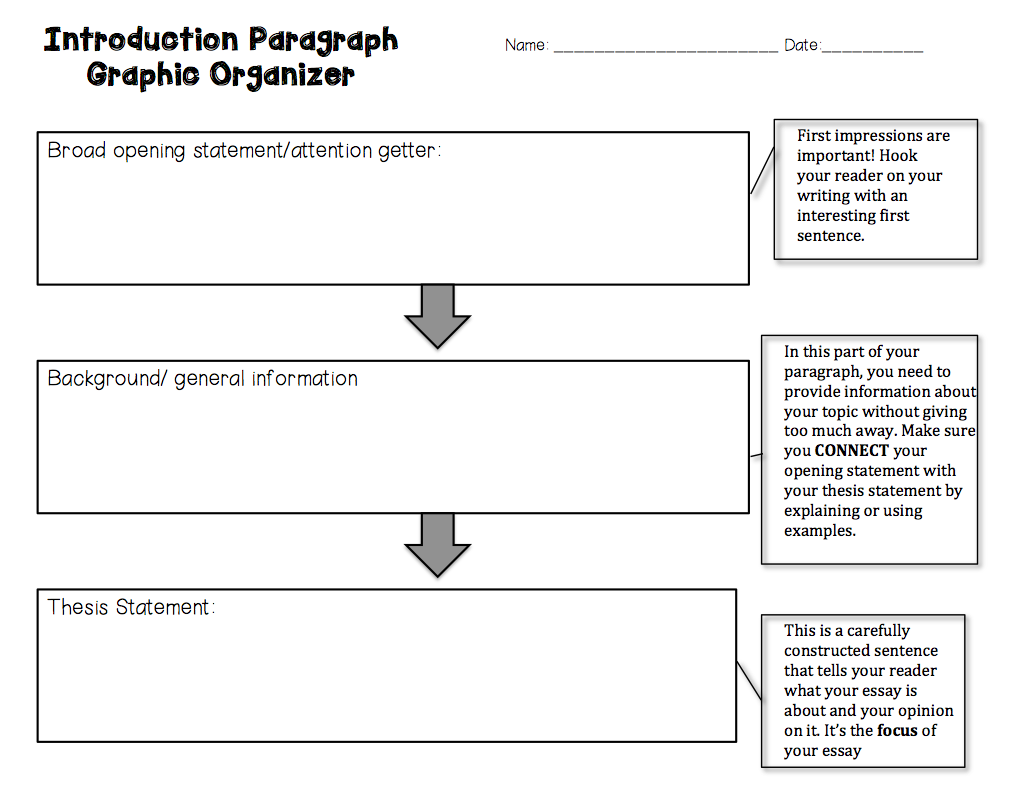
Introductions are so important because it's the first impression the reader gets about your essay, it provides a road map for the rest of your essay, it makes readers want to keep reading your essay, and it provides the writers opinion.

An introduction needs to have 3 things.

1. Something to get the readers attention or get them interested
2. Necessary background information
3. The thesis statement


This graphic organizer is something I created to help beginning writers write an introduction. 


Some strategies for writing the introduction are as follows:

1. Begin with a shocking statement. - Use some facts from a text that goes along with your essay or make a bold statement about the topic of your essay. This grabs the readers attention and makes them want to keep reading.

2. Ask a question- Ask a question and have your whole essay be a response to the question you posed. Be careful though. This is an "easy" way for students to start their essays and very often they get stuck using the questioning technique.

3. Begin with a personal anecdote - Make a connection to your essay! Refer to something that happened to you. This can be a VERY powerful way to start an essay because it makes the reader want to see how your experience unfolds throughout your essay.

4. Give historical background to set the scene- Depending on the topic of your essay, you might want to provide some background information to set the reader up to successfully understand your writing.

5. Use a quote from someone who is knowledgeable on the subject. Don't forget to give the author credit for their quote :)

6. Begin with a sensory description of the setting- Set the scene using descriptive words that pull the reader in.


If you would like to see a full PowerPoint Lesson with graphic organizers on how to write an introduction, thesis, and conclusion, click HERE.

Friday, February 20, 2015

Introductory Paragraph Graphic Organizer

Writing an introductory paragraph for young writers takes practice.

I have found that around 4th grade they get taught about "hooking" their reader in. An easy way for them to do that is to start with a question. So by 5th grade... all of them are starting their papers with questions! Now, there isn't anything extremely wrong about this in middle school, but it can get boring for the reader (aka ME). Sometimes I would like to shout, "There are other options out there people!" This means a huge part of my time is teaching the students other ways to start their essays.

To start teaching them how to write an introduction, I use this graphic organizer which I made. There are three sections

1. The broad opening statement/attention getter (*Note I didn't use the word HOOK since it is so strongly associated with asking a question for some reason)  
2. Background or general information 
3. The thesis 
 Introduction with thesis statement graphic organizer


To use this template, I start by modeling. I love modeling and I love my writing journal, so I model everything in a writing journal just like the ones the students have.

The writing prompt I use is usually one that I just made up that morning and it is usually from a novel we are reading. This way it is relevant to our reading curriculum too. So I model how to write an introduction from the prompt with a little help from the class. As I am doing this, the students are also copying what I am doing down on their own organizer which is cut and pasted into their journals for future reference. It becomes their own personal writing textbook.

The next day, I will have another writing prompt that is once again usually something I made up that morning and is usually from the novel we are reading. But this time, they will be the ones telling me what to write in the graphic organizer. Everyone has out yesterdays introduction to look at and I take lots of students comments and ideas and as a class we decide on what goes into that paragraph.

Depending on how quickly and how well they are catching on, on the third day I will have them do it on their own with a partner or go straight to trying it on their own. Days 4 and 5 are on their own practice. By the 5th, we also might be switching our introductions with a peer for editing.

One final thing I should mention is that I didn't give a specific number of sentences that the students should use. I will leave that up to you! As a general rule, we go with the five sentences minimum per paragraph. But with an introduction, some turn out very repetitive because they are trying to squeeze in an extra sentence whereas others need to make theirs longer.

If you would like a copy of my graphic organizer click HERE. This link also contains a graphic organizer for how to write a thesis statement.

Enjoy!

Thursday, February 5, 2015

Compare and Contrast Essays

Teaching students how to write compare and contrast essay can be tricky! It's not that they don't understand how to compare and contrast, but organizing the essay in a way that makes sense and is meaningful can be confusing!

Here is what I found. My students needed CLEAR structure. I gave them two options. Point-by-point organization where you write each paragraph about how they are alike or different. Or, they can use block organization where you write one paragraph all about subject A and the second paragraph all about subject B.

Although this can look confusing in a blank template, I designed a complete lesson for teaching compare and contrast essays that has a PowerPoint, blank templates, sample brainstorming, and sample essays to go along with the PowerPoint. Check it out here!


Tuesday, February 3, 2015

Paragraph Structure

Teaching the proper structure of a paragraph was so much fun using the hamburger method.

The reason I LOVED using this is because it really stuck with some of my struggling writers. I taught fifth grade, but about 40% of my class read below the fifth grade level. However, I didn't want them to write below the fifth grade level. And don't think the rest of the class didn't love this, because they did! Some students picked up right away how to write a well structured paragraph so they didn't need it for long. The rest, well they still asked to use it for a few weeks.

You can get my complete hamburger paragraph PowerPoint with lessons by clicking HERE for free! I used this powerpoint over the course of a week. We started the week by discussing what a paragraph is and WHY we write with the paragraph structure. Next, I showed some "good" and "bad" examples of paragraphs. Everyone could clearly see why it was important to write in paragraph form.


Next, we reviewed the parts of a paragraph where they took notes in their writers notebooks.


Note* I personally used composition books so the students could take their own notes about writing. This becomes a fantastic resources for them to use throughout the year.

From there, we practiced everyday for 1-2 weeks. I kept many, many copies of the blank hamburger in the room and students could take them as needed. We started by writing a paragraph together, then they tried with a partner,  and finally on their own. After each time we practiced, we shared as a class our writing and analyzed it using a rubric. Let me just say,  I. Love. Rubrics. when it comes to writing. It helped my students so much when I taught them how to use the rubric themselves.


Click the link to get my FREE PowerPoint off TeacherPayTeachers! Please leave some feedback if you download the link! Thanks :)